
A Mythological Conversation with AI
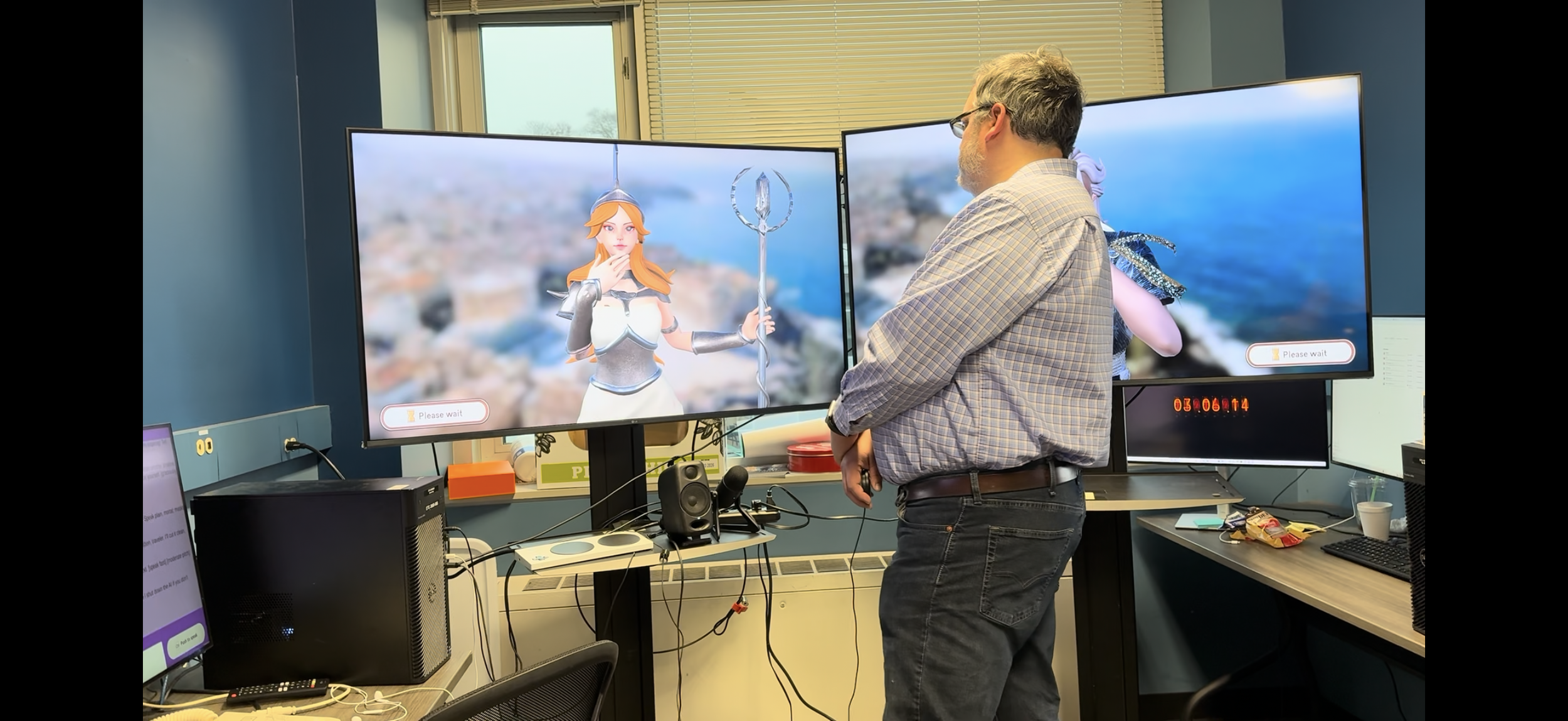
Athena and Poseidon are trading witty banter as a curious visitor looks on. It’s not a scene from Mount Olympus, but a high-tech lab at Carnegie Mellon University (CMU). There, a team of graduate students at CMU’s Entertainment Technology Center (ETC) has used artificial intelligence (AI) to bring these mythological characters to life. Their project, aptly named EchoTrio, lets people engage in a real-time conversation with two Greek gods and even watch the deities chat with each other.
The EchoTrio project’s poster shows a visitor standing in front of the holographic figures of Athena and Poseidon, a metaphor for the project’s blend of mythology and modern AI. The student creators harnessed a blend of tools: the Unity game engine renders the two godly avatars, OpenAI’s language model generates their dialogue, and 11 Labs’ speech technology gives them voices. Together, these allow Athena and Poseidon to converse naturally with a human user and, more interestingly, with each other in real time. According to the team, no one had ever built an AI experience like this, a seamless three-way conversation between a human and two AI characters, so they had to break new ground to make it work.
Making the Conversation Feel Natural
Orchestrating a trio of voices posed unique challenges. “If it’s just two AIs constantly jabbering, they start talking over each other,” explained Brian He and Terri Lim, EchoTrio’s programmers. The solution was to add a kind of referee behind the scenes. “You need this fourth entity under the hood mediating the conversation, saying like this one’s gonna talk now, then that one,” they explained. This hidden fourth AI manages the turn-taking, ensuring Athena, Poseidon, and the human speaker all get their say without chaos.
Equally important was imbuing the digital gods with personality and memory. The team chose Athena and Poseidon for their distinctive traits and rich mythology. They crafted detailed character profiles so that Athena comes across as wise and witty, while Poseidon is proud and boisterous. “They both have totally different personalities, and they have a sense of humor,” said Ye Wei, the project’s UI/UX designer, noting that kind of flair isn’t typical of many AI assistants. The AI gods even remember past interactions. “Once you introduce yourself, the AI will call you by name,” Shirley Saldamarco, the team’s instructor, pointed out, describing how the system retains context. In one demo, “one of the gods referenced someone who weeks ago had had a conversation with him; I thought that was amazing,” she added. That recall ability delighted the team, and it made the interactions feel personal, almost human.
From Experiment to Experience
While the technical achievement is impressive, EchoTrio’s creators have broader ambitions. From the outset, they outlined three goals for the project: first, to conquer the technical hurdle of enabling a three-way conversation; second, to craft an engaging experience around that technology; and third, to document everything for those who come next. In practice, that meant not just getting Athena and Poseidon to talk, but making their conversation fun and educational. The students initially envisioned EchoTrio as an interactive exhibit like in a museum setting, where kids or museumgoers could chat with life-sized Greek gods and spark a love of mythology. At the same time, the team recorded their process and challenges, creating a framework that future ETC teams can use to animate new characters. They have even floated the idea of one day bringing famous Pittsburgh figures like Andy Warhol and Andrew Carnegie into similar AI conversations.
Solving Silence, Timing, and the Awkward Pause
Of course, building EchoTrio was a trial-and-error process. Hong said the team encountered “hundreds of problems” along the way. One major hurdle was latency, or the slight delay while the AI thinks of a response. “The lag time was something we had to constantly deal with,” Hong noted. Rather than let awkward silences break the illusion, the team got creative. They added filler phrases and subtle animations to indicate a character was “pondering” a question. “You can soften the latency by creating a thinking animation,” Hong said, describing how Athena might pause thoughtfully so the audience knows she’s processing an answer. The students also discovered that body language mattered. They programmed the virtual Athena and Poseidon to glance at whoever was speaking or even turn to each other at key moments. These small design touches, from eye contact to timing gestures, kept the experience engaging and believable.
In building the conversation flow, the EchoTrio team drew inspiration from some familiar places. They studied the spontaneous banter of late-night talk shows, and they looked to interactive attractions like Disney’s “Turtle Talk with Crush.” In that popular Disney show, an animated sea turtle chats with audience members in real time, powered by a hidden human puppeteer. EchoTrio flips that concept on its head by using AI in place of a human actor. The team watched how Turtle Talk’s character engaged the crowd and aimed to emulate its lively, personable feel. Those references helped EchoTrio blend technology and storytelling, making the experience feel more like an entertaining show than a tech demo.
EchoTrio Gameplay
Ultimately, EchoTrio is both a technology experiment and a storytelling endeavor. It’s a proof-of-concept that advanced AI tools can breathe life into ancient legends, allowing people to literally talk to myths. The project’s extensive documentation may be invaluable for future developers, but its real triumph is in the here-and-now experience: standing in front of a screen, asking a question, and hearing two Greek gods answer you as if you were all gathered around the same table.
EchoTrio was created by a multidisciplinary ETC team: Brian He (Programmer/Technical Producer), Shiwei Hong (Producer), Terri Lim (Programmer), Aurora Liu (3D Artist), and Ye Wei (UI/UX Designer).
The project was developed under the instruction of Moshe Mahler and professor Shirley Saldamarco.