
How Remnants Nourishes Empathy for Caregivers of People Living with Dementia
“Wake up, sleepyhead, today I’ll teach you how to plant flowers.” After you walk under a trellis decorated with fragrant and multicolored blooms, a grandmother’s voice welcomes you to tend to the Remnants garden, located in the immersive and darkened CAVERN space at Carnegie Mellon University’s Entertainment Technology Center. In this garden, you are surrounded by both physical gardening props and a flourishing digital garden on the 270-degree curved screen.
With continued encouragement, “Good job, try the other flower box…Wow, you did it!”, you are invited to plant seeds in the wooden planter boxes and help care for the growing flowers in your grandmother’s garden.
As you continue to water and prune, the flowers wilt, the colors fade, and the weeds grow. What was at first clear, supportive guidance from your grandmother becomes more difficult to follow. Even as you continue the tasks, the garden’s future becomes unclear.
Remnants provides an immersive, emotional, and transformational experience for guests to understand and empathize with what it is like for a caregiver of a person living with dementia, a term that describes a collection of symptoms that can affect memory, thinking, behavior, and daily functioning. One of the most common forms of dementia is Alzheimer’s disease.
A Project Rooted in Experience and Empathy
This immersive and interactive installation was guided by several Remnants team members’ personal experiences with dementia, its progression, and its impact on their families.
The team, who advocated to work on this student pitch project, includes CMU ETC graduate students Melanie Danver (Artist and Producer), Zihan (Michelle) Fan (Producer and Researcher), Alex Hall (Hardware and Manufacturing), Jiaxin He (Narrative and Sound Design), Malaya Heflin (Programmer), and Riya Kanani (Programmer). The team was guided by CMU ETC instructors Shirley Saldamarco and Ricardo Washington.
The Remnants team shared that this project was important for them to pursue, both to raise awareness about dementia and to cultivate empathy. The team highlighted that the experience of caring for a person with long-term needs, including people who are living with dementia, can touch all our lives.
When immersed in the Remnants garden and by tending to the garden through its seasons of planting, growth, and change, guests experience the physical and emotional demands of continually supporting a person living with dementia as the condition progresses.
“We focused specifically on the garden as a relatable metaphor, as most people have taken care of a plant at one point in their life, even if it's just a small potted plant,” said Danver (Artist and Producer).
“Sweetheart, remember to water the flowers. Taking care of them can be tiring, you know. Sometimes you need to rest.”
Remnants unearths what remains in the garden, and in the heart, throughout it all. The team highlighted that when supporting a person living with dementia, there is still hope, and they embedded moments of beauty and resilience into the immersive experience.
Remnants Intertwines Physical and Digital Branches
Guided by the grandmother’s instructions, guests use physical props such as seed packets, watering cans, pruning shears, and garden claws to care for and nourish the flourishing and vibrant digital garden displayed on the 270-degree curved CAVERN screen.
Hidden technological elements, such as RFID readers, microelectronics, and accelerometers, that were not visible to guests, brought together the physical interactions of watering, pruning, and weeding of the Remnants garden with their digital responses on the immersive screen.
To start, guests tap a seed packet onto the corner of the wooden planters. The flower beds have an RFID tag reader to detect the type of flower seeds that were planted. In response, the planted seeds grow in the flower box garden on the CAVERN screen.
“We had a lot of different types of tech that we blended together. We used Steam VR virtual reality trackers, laser tracking, connect sensors, cameras, and the CAVERN screen, which used Unity, to track the general movement of guests in the garden space and what was happening with every single object. We were trying to be as realistic as possible to the experience of gardening,” said Hall (Hardware and Manufacturing).
“Oh, look at all the flowers you planted, just imagine how they will bloom.”
For the watering tasks, inside the watering can were Arduino microcontroller electronics that use an open-source electronics platform to combine circuit boards and programming software. “These interactive props, such as the watering can, were 3D printed shells with electronics inside,” shared Hall. “And for the watering can, it has two weight chambers in it that pump water from one side to the other, mimicking the feel that there is water draining from it based on where the handle is.”
“Child, remember to water the flowers every day, they need you.”
As guests used the garden claw to remove weeds from the garden soil, which was made of plastic to resemble dirt, accelerometers detected this interaction. On the CAVERN screen, guests see and hear the weeds being removed from the garden.
This level of spatial engagement using physical props was new for the CAVERN space. “We learned a lot about what it was like to move around in the space, specifically with using a lot of different objects. Through the documentation on our website, others can learn what worked in this physical installation environment and what did not. And we're hoping that we can pass on that knowledge,” said Hall (Hardware and Manufacturing).
Nourishing Empathy Through Immersion
“One of our goals was to understand how effective an immersive experience can be to foster empathy,” said Fan (Producer and Researcher).
The experience and interactive design were created specifically with dementia caregivers in mind. One of the team’s inspirations was a documentary film that they watched together, Wine, Women & Dementia, which follows a woman who visits in-home caregivers of people living with dementia. “The film really helped us realize, from a caregiver’s perspective, how much both the person living with dementia and the caregiver struggle. Not only with the physical tasks, but also the emotional strain of watching someone you care about change in ways that affect memory and connection,” said Heflin (Programmer).
Visitors from Seniors Blue Book, a local organization with ties to the dementia caregiving community, were included in playtesting of the Remnants’ experience. “The caregivers who experienced Remnants showed an emotional connection with it,” said Kanani (Programmer). The team used the professional insights and resources shared by the Seniors Blue Book participants to create an informational pamphlet that guests would receive upon leaving the Remnants garden.
“While it's difficult to measure empathy, it was meaningful talking to members from the Senior Blue Book when they tested the Remnants experience. It was really rewarding for all of us to see how an immersive experience can offer guests a new perspective and topics to think about,” said Heflin (Programmer).
A Transformational Moment
What started as a flourishing garden begins to show signs of change. “We wanted to balance the programming of Remnants so guests can understand the evolving challenges of supporting a person living with dementia. The gardening starts with a small task, and as the storyline progresses, the tasks become more repetitive and time-consuming,” said Kanani (Programmer).
Remnants also draws attention to the emotionally challenging aspects of caretaking for a person living with dementia, whose symptoms can influence behavior, feelings, and relationships.
“Who are you? Why are you in my garden?”
“A key takeaway for me, as a narrative designer for the experience, is that you should test if the emotional aspects of the narrative are working as soon as possible, even when you have just the start of the narrative developed,” said He (Narrative and Sound Design).
The team acknowledged that along with the emotions related to the garden’s changes, there are also moments of joy in the caregiving journey. “You do have some joyful moments when you're supporting someone you care about,” said Fan (Producer and Researcher). “That's why, even as the garden fades, we added beautiful moments, like butterflies, to show that there are good moments that you want to remember.”
“That’s why I planted so many flowers that attract butterflies; they bring so many of them here. [Laughter] See how beautiful they are?”
The Power of Community in Caregiving
The gardens of our memories, relationships, and experiences take a lifetime to grow and evolve. As the Remnants garden begins to change and the flowers wilt, the color saturation on the CAVERN screen decreases.
The team observed that when one person tended the Remnants garden alone, they paused earlier and moved more slowly through the narrative experience. “When more people experienced Remnants together, there was much more collaboration, more trying different things, and they continued with the same amount of effort throughout the experience. And that also mimics real-world caregiving. When you have people supporting you, it's a lot easier to keep going than when you're alone,” said Kanani (Programmer).
As the colors continue to fade and the lights dim, it begins to feel as though the garden’s growth has stopped. But a remnant remains, rooted in the design of the experience. “At this point, if guests keep watering and keep tending the garden, they will see the remnants of the garden,” said Fan (Producer and Researcher).
In the darkened room, on the desaturated immersive screen, a single flower grows, glows rose-pink, and blooms.
“My child, it’s nice to see you again. Where are the remnants of my garden?”
Raising Awareness and Strengthening Resilience
After leaving the immersive garden, guests learned that the story reflected the experiences of caregivers supporting people who are living with dementia. The Remnants team offered guests a pamphlet dedicated “to those who have forgotten and to those who loved them through it all.”
The pamphlets provided information about dementia to further raise awareness. “A lot of people avoid talking about dementia and caregiving because it can feel uncomfortable or scary. With Remnants, we wanted to challenge misconceptions and create an experience that encourages early recognition, supports understanding of dementia's progression, and fosters empathy,” said Fan (Producer and Researcher).
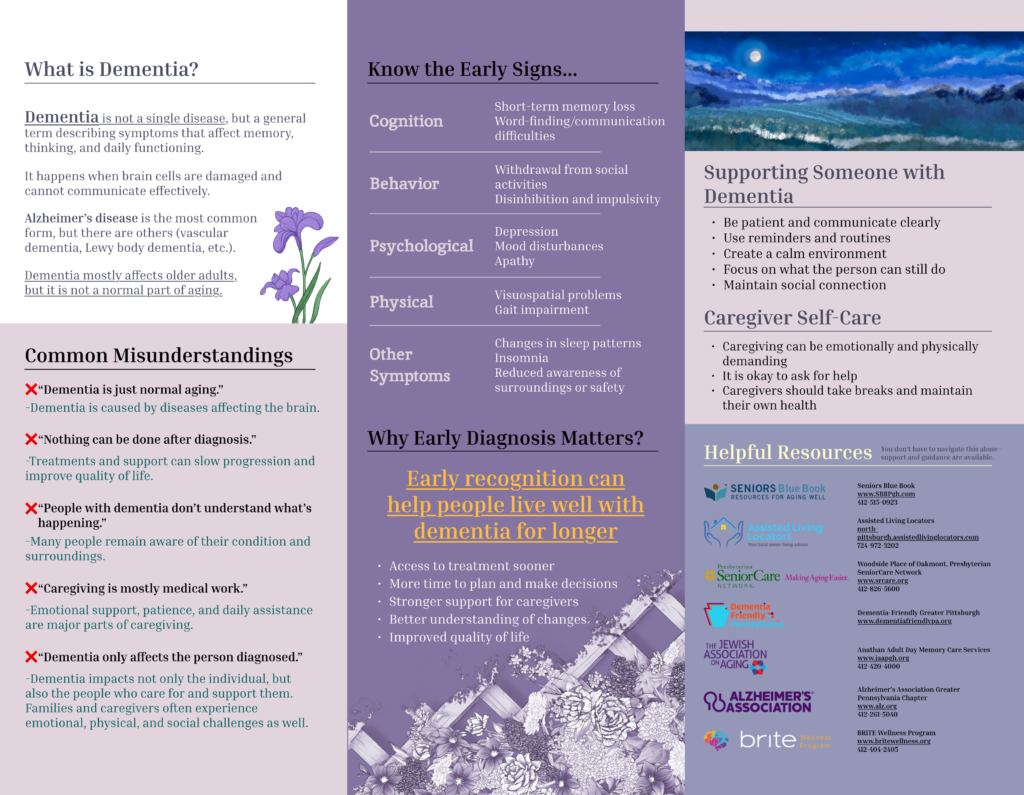
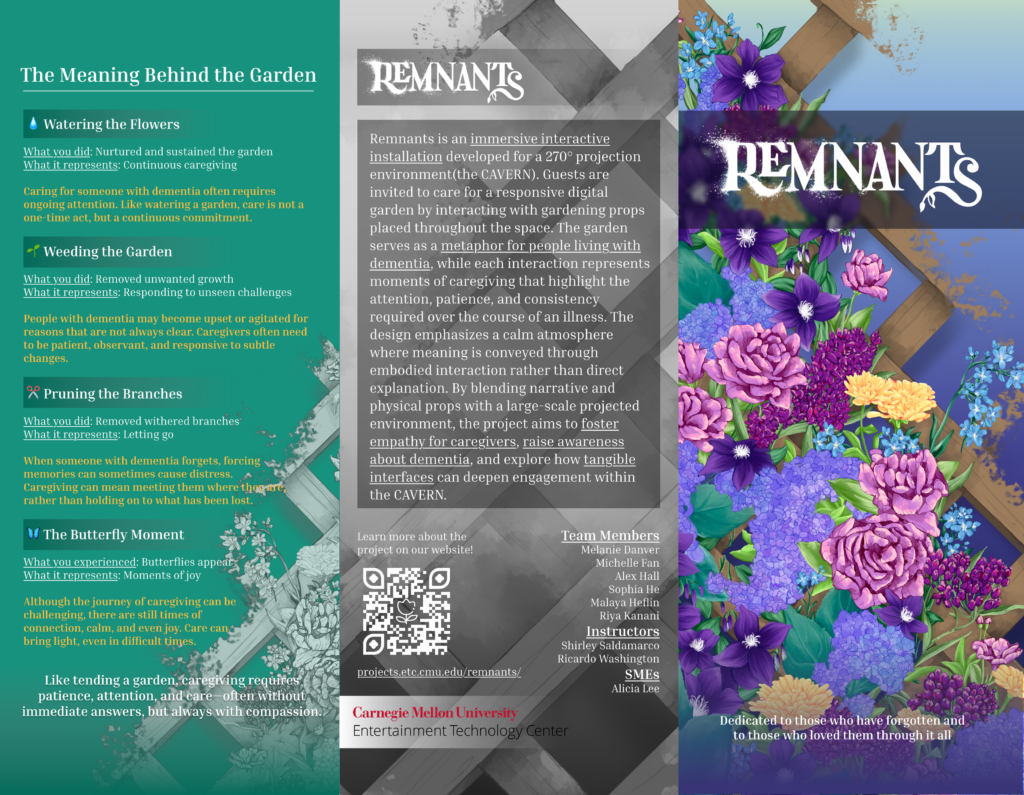
Remnants is an exploration of immersion, experience, and empathy for those who are supporting someone who is living with dementia, a condition for which there is no cure.
“Within the enclosed CAVERN space, interactive design elements like visuals, sound, scent, and story help us to create an experience that fosters empathy. And even if it's difficult to measure empathy, you can hear it in the conversations people have afterward. It shows the impact immersive experiences can have on those who engage with them,” said the Remnants team.
Remnants demo video. View the full experience walkthrough. Source: Remnants Team.
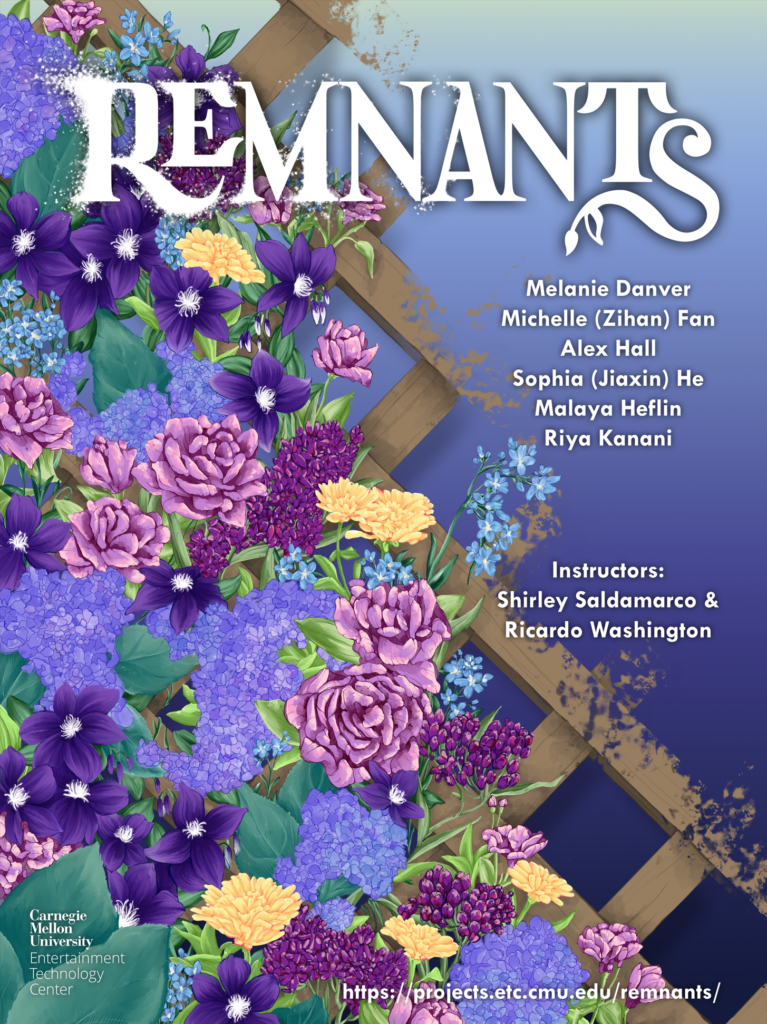
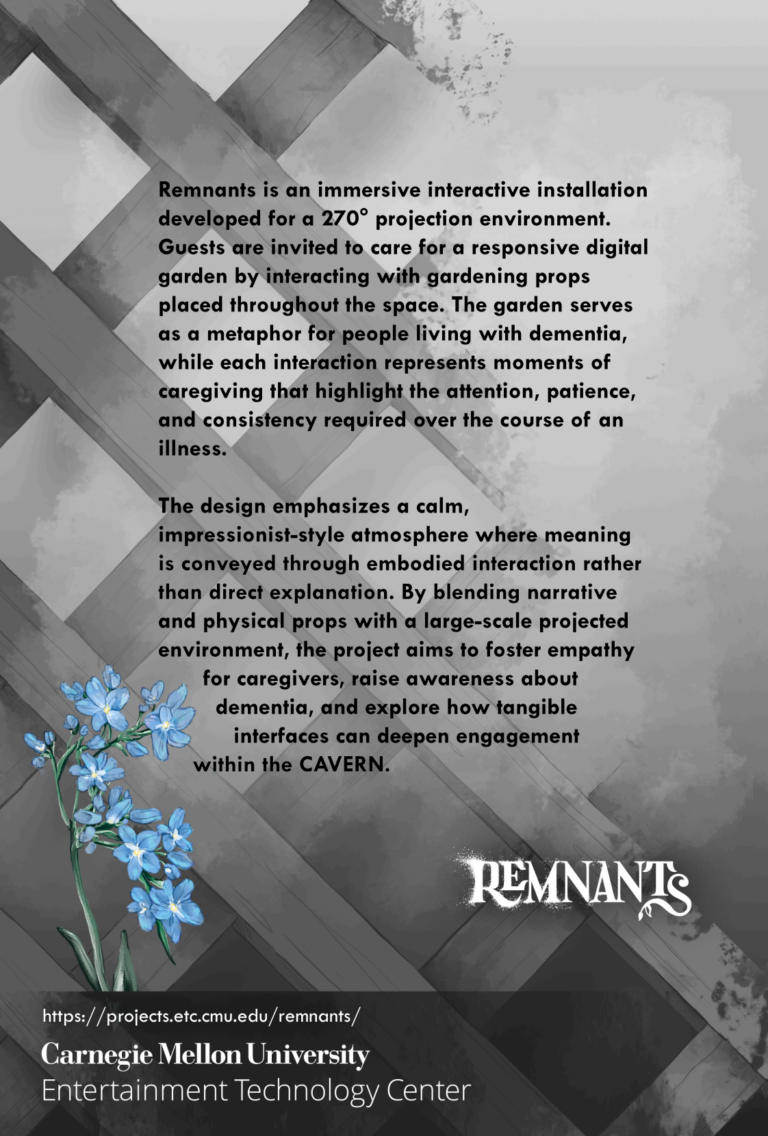
Note: The quotes indicated in italics are from the Remnants narrative and audio experience.