
ETC’s Interactive Storytelling Takes Flight in the Classroom
Once upon a time, in a middle-school classroom in Pittsburgh, students were studying art and engineering. Every day, in school, in activities, and at home, they learned new things, including watching movies and playing games, but could these skills be something they would pursue with higher education in the entertainment technology industry?
Until one day, Dawn, an animatronic owl that could turn its head, move its beak, and flap its wings, visited the classroom. Because of that, Dawn was ready to take flight in students' imaginations, sparking their awareness and inspiring them to pursue careers in the entertainment technology industry.
Little Owl Construction Co., a team of graduate students from Carnegie Mellon University’s Entertainment Technology Center (ETC), identified, distilled, and concentrated the essence of studying and working in the entertainment technology field. The result was a collaborative and interactive storytelling experience designed for students, with a focus on using and increasing knowledge of creative technologies.
Until finally, the middle-school students gathered around and worked together at various storytelling and technology platforms set up in the classroom to ideate, create, and launch Dawn’s story, complete with sound, lighting, and movement. Dawn’s journey took unexpected comedic and sometimes tragic turns, such as going to outer space, encountering the end of the world, or just feeling happy.
The Little Owl Construction Co. team included Jasmin Ali-Diaz (Co-Producer & Hardware Engineer), Ean McFadden (Co-Producer & Sound Designer), Melanie Danver (2D & 3D Artist), Devika Santosh (UI/UX Designer, Courtney Singleton (Programmer), and Dawn (Mor-Owl Support & Mascot). CMU ETC instructors who provided support, as needed, were Drew Davidson and Shirly Saldamarco.
This project was for a client, John Balash, a CMU ETC alum and Director of Academic Outreach, Extension, and Engagement Department at the ETC. Balash asked the Little Owl Construction Co. team to “distill the ETC to its simplest form and design an experience around that core,” said Ali-Diaz (Co-Producer & Hardware Engineer). The team co-designed this project with the Boys & Girls Clubs of Western Pennsylvania, with funding from a grant from the Grable Foundation.
An Invitation to Imagine, Interact, and Collaborate
Middle School students were welcomed with a letter from the Little Owl Construction Co. team inviting them to the ETC collaborative and interactive storytelling experience. When students enter the classroom, they see Dawn perched in front of a TV screen and five interactive platforms to bring Dawn’s story to life by adding the owl's story, movements, sound effects, lighting, and the background setting.
While Dawn was at the heart of the story, the real main characters are the students writing it together. Students were given a creative prompt and a set of words to choose from to get started, but as the story went on, they had the chance to write their own stories for Dawn and decide how the story would end, all with the guidance of a facilitator with experience in child education.
Storytelling may seem difficult, but we all have experience creating and consuming stories. Take a moment right now to think of your favorite movie to watch or story that you like to tell.
This story most likely has Characters, Relationships between characters, an Objective, and there is a specific place Where the story takes place. This is referred to as CROW, the storytelling framework that students used in Little Owl Company Co.’s immersive educational experience.
Related to foundational storytelling and creative technology, Santosh (UI/UX Designer) said, “The Science Behind Pixar was in Pittsburgh at the time, and we were inspired by this Carnegie Science Center exhibit, including for the use of stations and the overall color palette”. While CROW was used in the classroom to keep stories focused, the team also explored the use of The Pixar StoryStructure, based on Kenn Adams’s Story Spine, which begins with “Once upon a time…,” moves to “But one day…,” and concludes with “And ever since then…”.
“The Science Behind Pixar was in Pittsburgh at the time, and we were inspired by this Carnegie Science Center exhibit, including for the use of stations and the overall color palette.”
Movement, Lighting, Background, Sound: Assembling the Building Blocks of Entertainment Technology
With Dawn’s story in place, the students moved to the interactive stations around the classroom to add movement, lighting, backgrounds, and sound.
“A lot of students had preconceived notions about whether they were an artist or a designer,” said Singleton (Programmer), reflecting on the experience for students, adding, “We decided not to use those labels like ‘artist’ or ‘programmer’ so students wouldn’t be limited to try.”
At the Movement Station, students used code blocks, which contain a set of code and act as a puzzle piece, to learn how coding can make Dawn’s head turn or wings flap. “The students can see how their actions can have an impact in the physical world, said McFadden (Co-Producer and Sound Designer), “seeing something move in the physical world is a magical experience, and the students would get really excited about that.”
“A lot of students had preconceived notions about whether they were an artist or a designer. We decided not to use those labels like ‘artist’ or ‘programmer’ so students wouldn’t be limited to try.”
At the same time, another group of students designed the story setting at the Backdrop Station. Students could draw from scratch, use coloring pages, add stickers, or use the available Little Owl Construction Co. backdrops to create the world where Dawn’s story would take place.
Final storytelling touches were provided at the Lighting Station and Sound Station. At the Lighting Station, students learned how to control and mix the red, green, and blue (RGB) values to create lighting colors for the performance. And at the Sound Station, students chose from a selection of 70 ambient sounds, background music to convey emotions of boredom, sadness, and fear, and sound effects, including dripping water, bubbling lab equipment, beeping electronics, and a bird’s squawk.
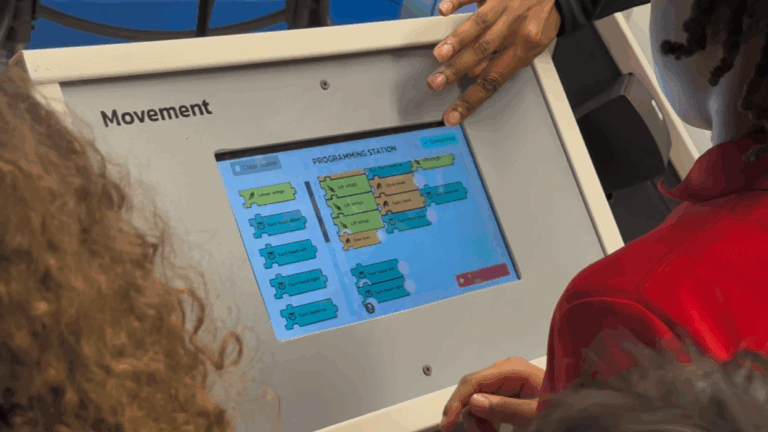
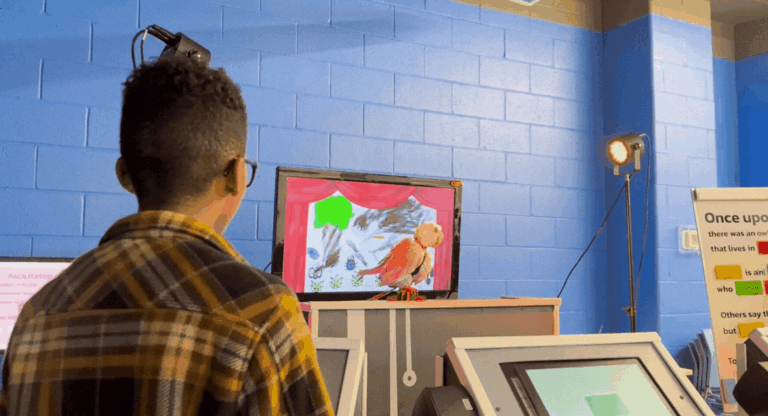
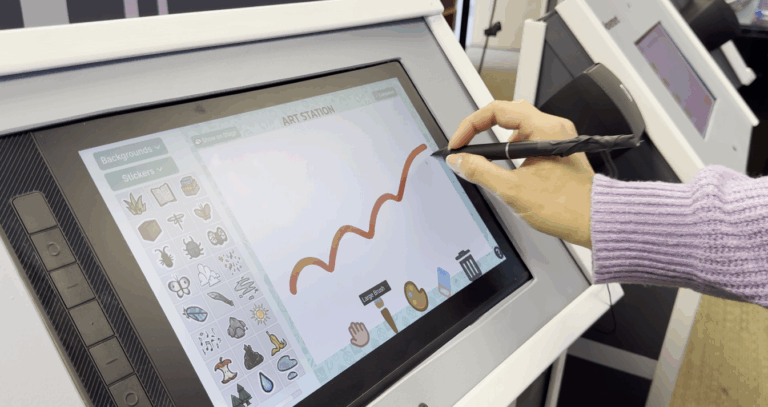
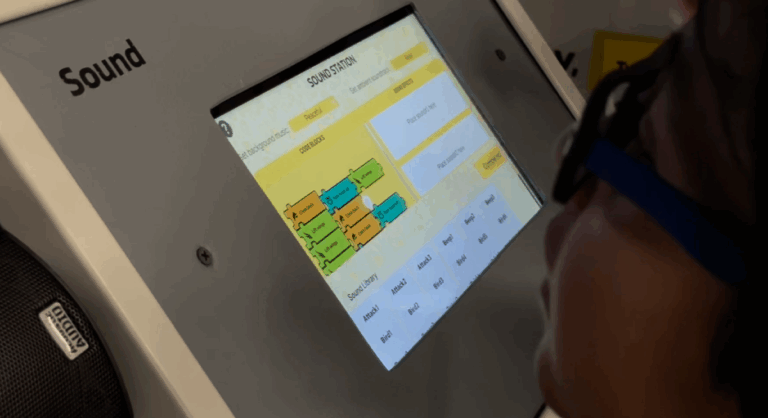
“The students can see how their actions can have an impact in the physical world. Seeing something move in the physical world is a magical experience.”
Creating an Educational Platform for Interactive and Collaborative Storytelling
To transform the core that exemplifies what it's like to work in the entertainment technology industry into an experience, the Little Owl Construction Co. team wanted to make something. “We wanted to have a focus on fabrication,” said Danver (2D & 3D Artist). The team has collective expertise in engineering, theatre, location-based entertainment, science communication, animation, visual storytelling, experience design, immersive experiences, computer sciences, and web development.
With inspiration in mind, the team designed and built physical elements to be transported to classrooms for the Little Owl Construction Co. experience. “Going into this project, I wanted to do a location-based experience project. I was very excited to work on it. Towards the end, there was a lot to do to make sure everything was ready to go,” said McFadden (Co-Producer & Sound Designer).
Dawn the owl was created using Bottango’s Maxwell Kit, which is a parrot animatronic with open-source software. “Using clay and crafting materials, I made sure that Dawn could be viewed from all angles to bring the character to life,” said Danver (2D & 3D Artist). “This was my first time working with an animatronic, and I had to make sure that things weren’t too heavy so it could still move.”
“It was a big bonding experience for us to be building together,” said Ali-Diaz (Co-Producer & Hardware Engineer), “We spent time in the woodshop, building the designs that Melanie Danver (2D & 3D Artist) created from planks of wood.” This included the set, the podiums, and the frame for the classroom setup. “We also had a painting session to make the set, podiums, and frame for the classroom,” said Ali-Diaz (Co-Producer & Hardware Engineer).
“Using clay and crafting materials, I made sure that Dawn could be viewed from all angles to bring the character to life.”
Dawn’s Future Horizons
Students gathered around Dawn and the TV to watch as the story they had imagined and the world they had built together came to life through movement, lighting, sound, and the background setting.
“By using stories and the fantastic methods that produce them, we help children enter reality through the window rather than the door. It is more fun, and therefore, also more useful,” wrote Gianni Rodari, the author and educator known as the father of modern Italian children’s literature, in The Grammar of Fantasy: An Introduction to the Art of Inventing Stories, from the 2025 English edition translated by Jack Zipes. In this quote, Rodari describes this approach as “placing oneself at the service of children’s imagination,” emphasizing the importance of meeting children where they are and providing them with support and safety.
Students engaging with Dawn and the Little Owl Construction Co.’s interactive platform had the chance to imagine a story and a world, gaining insight into what it’s like to work in the entertainment technology industry.
After piloting the prototype interactive storytelling platform and experience in the classroom, the Little Owl Construction Co. made notes to inform future work on the project by the ETC Outreach, Extension, and Engagement office. These ideas include enhancing Dawn’s animatronic design to be more robust by using a Lego kit, making the owl easier to fix, ensuring the platforms are wheelchair-accessible, incorporating additional language presets, and adding more code blocks to the Movement Station so Dawn can make more complex movements.
Other ideas being explored include a Cyber Bus with tech and other supplies that can be brought to schools or even a permanent fixture, perhaps with a moveable character or touch screens, at the Boys & Girls Clubs of Western Pennsylvania.
“Students were excited to work together and write their stories,” said Ali-Diaz (Co-Producer & Hardware Engineer). “The students know about games and movies, but not many students were aware that this is a job you can have. During the classroom experience, students shared ideas for the future and even said that they wanted to visit the ETC when they were in graduate school.”
“During the classroom experience, students shared ideas for the future and even said that they wanted to visit the ETC when they were in graduate school.”